From a child’s first experience at Critter Camp to working adults pursuing new credentials online, the Nebraska College of Technical Agriculture (NCTA) Veterinary Technology program is building career pathways that span generations and remain strong in a rapidly changing workforce.
At a time when many industries are being reshaped by automation and artificial intelligence, careers in animal health continue to rely on hands-on skills, critical thinking, and human-animal interaction, making them both essential and resilient.
Through what NCTA now calls an AgVantage, a hands-on, industry-connected, career-focused approach, students of all ages are gaining real-world experience that translates directly into meaningful careers.
That impact begins early.
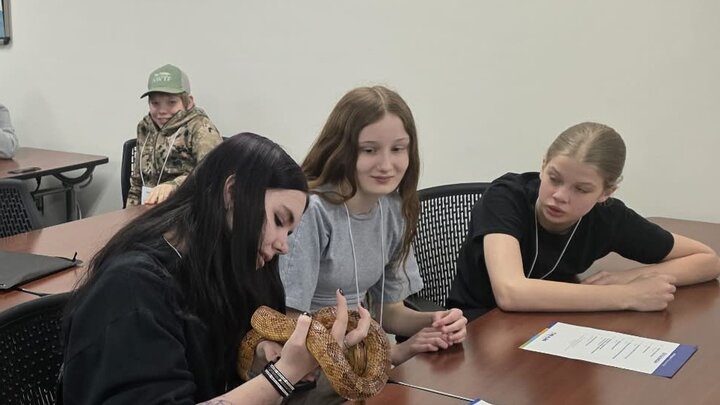
On March 19, NCTA veterinary technology faculty traveled to North Platte for the annual Expanding Your Horizons event at Mid-Plains Community College. Now in its fifth year of participation, NCTA continues to introduce junior high students to careers in veterinary medicine through interactive, hands-on learning.
Dr. Crystal Rhine, Stephanie Howell, and Chrissy Barnhart led a session titled “From Nose to Tail: What It Takes to Care for Animals,” where students explored career paths in animal health while meeting animal ambassadors from NCTA.
“Sometimes the best way to explain what we do is to let the animals do the talking,” said Dr. Crystal Rhine, assistant professor of veterinary technology. “When students can see and experience it for themselves, it creates excitement and helps them begin to picture their future.”
A Legacy of Hands-On Education
NCTA’s approach is rooted in more than a century of innovation. Established in 1913 as the Nebraska School of Agriculture, the institution began as a high school of agricultural excellence, an extension of the University of Nebraska’s agricultural college in Lincoln. Its creation predated Nebraska’s community college system by decades and helped pioneer accessible, workforce-focused education in rural communities.
That same commitment to hands-on learning continued in 1974, when NCTA’s Veterinary Technology program became the first accredited two-year program in the nation.
From First Experiences to Career Outcomes
NCTA’s Veterinary Technology program creates a seamless pathway from early exposure to career placement.
Younger students can explore their interest in animal care through outreach events and summer programs like Critter Camp, where hands-on experiences spark curiosity and confidence.
On campus, students build on that interest through immersive coursework, working daily with animals of many species—large, small, and exotic—in clinical and laboratory settings.
Students gain exposure to specialized career paths through visits to Omaha’s Henry Doorly Zoo and Aquarium, where they observe advanced care across a wide variety of species. Through a biennial study abroad Safari Club trip to Costa Rica, students engage with wildlife, conservation practices, and international approaches to animal care.
An innovative opportunity for those in livestock or animal science appreciating the value of working dogs has evolved into a one-of-a-kind team. NCTA is home to the nation’s only collegiate Stock Dog Team, where students train and compete in cattle dog association events, further strengthening their skills in animal behavior, handling, and livestock management.
Students preparing to graduate in May are in the final stage of their two-year journey, an intensive eight-week internship. These placements provide hands-on experience in veterinary clinics, animal care facilities, and specialized operations across the country. For many, the transition from student to professional happens quickly, with job offers coming directly from internship sites or from a wide network of employers eager to hire NCTA graduates.
Meeting Learners Where They Are
NCTA’s reach extends beyond traditional students. Through its expanding online veterinary technology option, the program is serving adult learners already working in veterinary clinics and animal care settings. This flexible pathway allows students to advance their credentials while continuing to work, strengthening both their careers and the industry.
“Our program is designed to meet students where they are,” Rhine said. “Whether it’s a junior high student discovering an interest, a recent graduate starting college, or an adult learner building on years of experience, we provide a pathway forward.”
Built for the Future
As technology continues to evolve, veterinary technology remains a field grounded in hands-on care and real-time decision-making. While artificial intelligence can support aspects of the profession, it cannot replace the human skill, judgment, and compassion required in animal health.
At NCTA, that reality reinforces the value of an AgVantage education, one that prepares students not only for today’s workforce, but for careers built to endure.
Contact Dr. Crystal Rhine for more information.